


How The Scottish Highlands Became a Hiker Destination

Updated: Apr 19

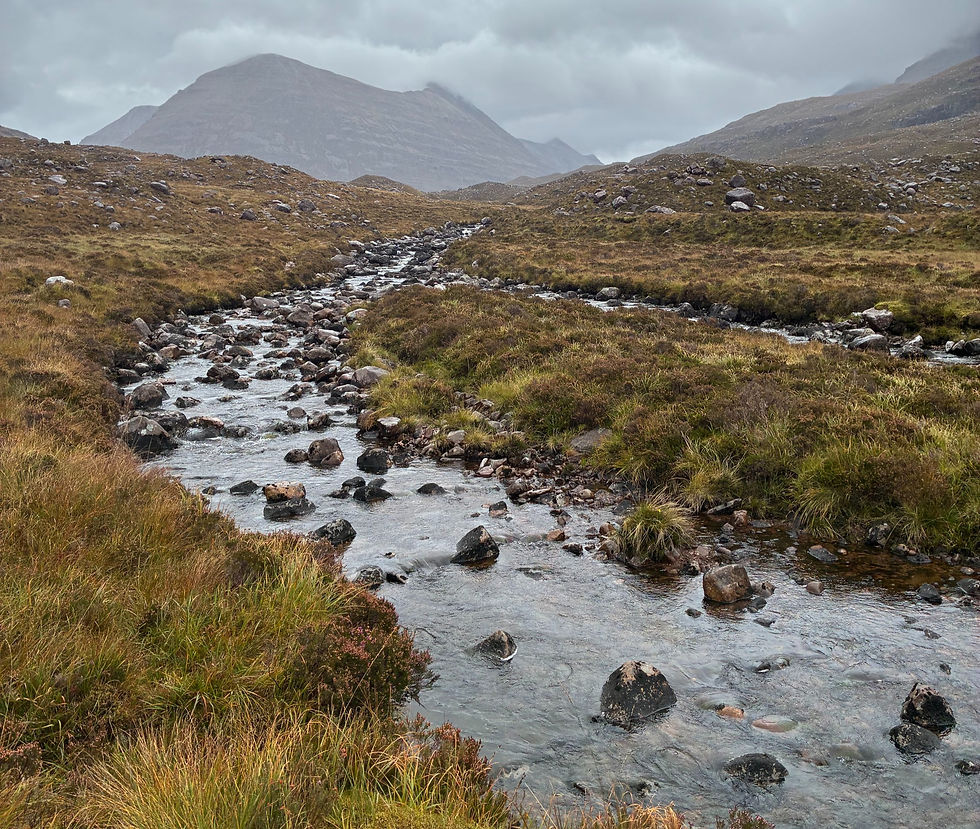
The Scottish Highlands - located in northern Scotland between the North Atlantic Ocean to the west and the North Sea to the east - are noted for cool, cloudy, rainy maritime weather; endless, grassy moorlands; brooks of clean, cold water; fresh air, beautiful lochs and, of course, the storied Scottish clans.
The Highlands map, below, shows the historic clan territories. A big gash is visible, right down the Highlands' midsection, as if a giant warrior sliced the Highlands from northeast to southwest with a huge, two-handed claymore broadsword - the favored weapon of Highland warriors from early medieval times. The gash, known in Scotland as The Great Glen, starts at Moray Firth on the North Sea, and cleaves southwest to Loch Ness, to Loch Lochy, to Loch Linnher, and finally to Firth of Lorn on the extreme southwest, opening into the Atlantic Ocean. Surrounding the gash are territories belonging to clans Urquhart, Rose, Grant, Fraser, Cameron, and MacLean, to name a few.

The Highland clan system started evolving in the twelfth century and over succeeding centuries developed into distinct patriarchal communities, each led by a hereditary chieftain, known as the Lord, and his family. As the clans developed they accumulated, by agreement or combat, large territories including the native subsistence farmers ("crofters") who lived there. The crofters and their families, like the land they lived on, became the Lord's property. Crofters pledged loyalty to the Lord, sometimes adopted his name, paid tribute to him and his family, provided warriors for territorial security and, when necessary, to attack other clans' estates. In return, the crofters looked to the Lord for a cut of the clan's booty, produce, security, and a portion of land to work and feed their families.
Highland warriors, all members of various Scottish clans, carried their claymores during the Jacobite uprising of 1745, an ill-advised military campaign to invade England, depose King George II of the House of Hanover, and replace him with King James of the House of Stuart. The term "Jacobite" comes from the Latin name Jacobus, which means James.
A year into the uprising, English Redcoats defeated the warriors at the Battle of Culloden. The Redcoats, being highly disciplined soldiers, formed into tight ranks and fired their flintlock muskets in mass and on command at the charging warriors, killing well over a thousand. Although the Redcoats prevailed they were not unscathed. A few warriors made it through the musket fire and butchered hundreds of Redcoats with their claymores. But it was a lopsided victory for the English. After Culloden, King George prohibited the wearing of kilts and display of the claymore sword, which only served to enhance its reputation as a cruel close-combat weapon.
Culloden was the beginning of the end for the Scottish clans and, some historians say, Scottish Highland culture. Lords were now required to pay a tax to the British Crown, which meant their vast territories had to convert from patriarchal subsistence communities to profit making agricultural enterprises. The Lords turned to sheep ranching, which was profitable but required open, grassy ranges - like the Highlands. They started clearing the crofters from their native territories and razing crofter villages to make room for the sheep. The clearances, known to history as the Highland Clearances, started shortly after Culloden and lasted for about 100 years, or into the mid-nineteenth century.

The clearances were devastating for displaced crofter families. Suddenly, clan patriachs and their descendants, who had guaranteed the crofters security and purpose for generations, became indifferent, uncaring, rent-seeking landlords. Archibald Geike, a noted 19th century geologist, witnessed the clearing of Suisnish, a crofter village of the Lord MacDonald estate on the Isle of Skye. Geike described the pitiful scene:
"I could see a long and motley procession winding along the road that led north from Suisnish . . . There were old men and women, too feeble to walk, who were placed in carts; the younger members of the community on foot were carrying their bundles of clothes . . . while the children, with looks of alarm, walked alongside . . . A cry of grief went up to heaven, the long plaintive wail, like a funeral coronach, was resumed . . . the sound re-echoed through the wide valley of Strath in one prolonged note of desolation."
The doors of the crofters' homes were nailed shut and the thatched roofs were burned. There would be no return to home. The scene was played over and over throughout the Highlands for a hundred years, from 1750 to 1860. While a chosen few of the crofters managed to stay on and work for their Lord, hundreds of thousands more, including many thousands who were sold by their Lord into indentured servitude, immigrated to the Americas and Australia. Others immigrated to the cities and found menial jobs.
Today, Scotland's government estimates that 98% of Scotland's land mass is rural. ("Land Reform (Scotland) Bill: business and regulatory impact assessment," Section 2.2.1. , March 14, 2024.) About 83% of that rural land is privately owned, and 50% of that is owned by a mere 433 families. (Wightman, Andy: "Who Owns Scotland 2024," Land Matters (publisher),December 8, 2025 (https://andywightman.scot/2024/03/who-owns-scotland-2024-a-preliminary-analysis/)). Most of those 433 families are descendants of the original clan Lords or English royalty, a handful of others are recently arrived billionaires, including an Arab sheik or two, who have simply purchased the land. Thus, 433 families own 41% of Scottish real estate.
Predictably, the high concentration of land ownership has caused political friction. So in 2003 Scotland enacted the "Land Reform (Scotland) Act," providing that "a person has access rights" to privately owned land for hiking and camping as long as they behave "responsibly" (i.e., don't get too close to owners' houses, don't damage anything, leave the animals alone, leave no trace, etc.). The 2003 law is popularly known as the "right-to-roam law" and it opened the old clan estates to hikers and campers, though the land is still privately owned.

We hiked across the extant MacDonald estate to the ruins of Suisnish on the Isle of Skye. There is just enough there to prove Suisnish was an ancient village populated by hundreds of crofters. The ruins of the local church, Christ Church, served a number of nearby crofter villages and was constructed sometime during 1400 to 1500 ACE to replace an older, original church, which was constructed during the 7th century ACE. The church originally served a Catholic congregation, which was the religion of most Highlanders at the time.
In 1627, about two-hundred and thirty years before Suisnish was cleared of its crofters, and over eighty-seven years after the beginning of the Scottish Reformation - the long and often violent process of Scotland’s break from the Catholic Church - Christ Church received its first Protestant minister, Neil MacKinnon.


Reverend MacKinnon was of Clan MacKinnon, a smaller clan that pledged allegiance to and was eventually absorbed into Clan MacDonald. Upon his appointment to Christ Church, MacKinnon, "gave his grite and solemn oath that he shall treulie according to his knowledge, give up to the Clerk of Councell the names of all the Papists he knew within the Isles." In other words, he saw it as his mission to out all the Catholics he knew so they could be forcibly converted to Protestantism, or chased out of the Highlands, or worse. MacKinnon always wore Highland dress while preaching and "from the distracted state of the times never went to the pulpit without being fully armed." (Rev. Donald MacKinnon, "Memoirs of Clan Fingon" (Lewis Hepworth & Co, 1899), at pages 28-31).

MacKinnon apparantly had near total control over the lives of the crofters in his parish, including how much food they got. He provided them two meals per day, except on Sundays when he provided only one. His rationale was that since his crofters didn't work on Sunday, one meal was sufficient. But MacKinnon changed this policy after two hungry crofters planned a peaceful and subtle demonstration on a Sunday afternoon after church services. The two made a point of ploughing the field outside the church as MacKinnon and his associates were walking out. MacKinnon saw the two ploughing the field with a hand plough, got the message, and agreed to provide his crofters two meals on Sunday.
The clearances happened all over the Highlands. It is the reason so much of Scotland's rural land is owned by so few, and why so much of it is undeveloped and dedicated to sheep grazing, even today. The 2003 right-to-roam law is a reckoning of sorts, intended to force landowners to share the land. A benefit is that the Highlands have become a hiker and camper destination. Tourism accounts for about 5-6% of Scotland's gross domestic product, or about four billion pounds per year, or almost three billon dollars.
So, it's all good.
Additional photographs follow:




THANKS FOR READING MY BLOG!
Scroll down for more articles.


Loved the Scotland blog, Joe. Very, very informative, and great photos!